
RSM Blog: Sports Medicine and Massage Insights
Kinetic Chain Training on Unstable Surfaces for Dynamic Postural Assessment
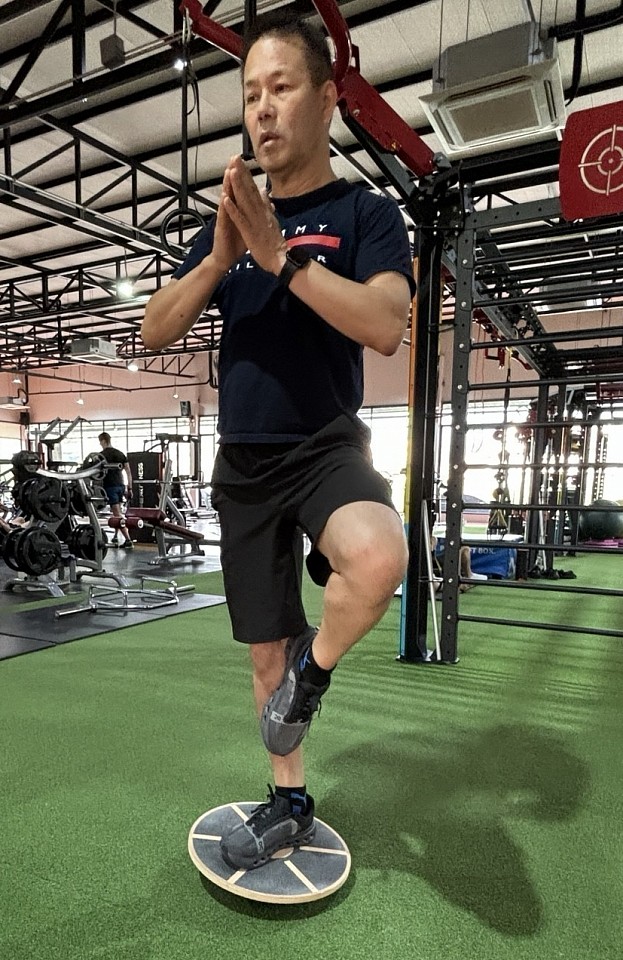
Dynamic postural assessment with balance disk
In Sports Medicine-Based Performance Training, the development of neuromuscular integration through unstable surfaces—such as BOSU and balance balls—is fundamental. These tools challenge both the ascending and descending kinetic chains, forcing the body to maintain alignment through constant micro-adjustments. Each subtle movement activates proprioceptors and enhances intermuscular coordination, promoting a dynamic equilibrium between the body’s Center of Gravity (COG) and the base of support.
At RSM International Academy, this method is not used for simple balance exercises but as an advanced clinical approach to Dynamic Postural Assessment. Through controlled instability, practitioners evaluate how kinetic chain dysfunctions and pain-avoidance postures (PAP) manifest under load and motion. By analyzing compensatory mechanisms and re-educating proprioceptive pathways, students learn to correct postural inefficiencies and restore functional movement.
This form of neuromechanical conditioning creates adaptability across joints and fascia, stabilizing body axes through both ascending and descending kinetic synchronization. Ultimately, the athlete or therapist gains refined control of postural reflexes—vital for pain reduction, joint mobility, and long-term athletic performance.
- Hironori Ikeda, MSc Sports Medicine
Neurodynamics & Sports Biomechanics Specialist
References:
1) Behm, D.G., & Colado, J.C. (2012). The effectiveness of resistance training using unstable surfaces and devices for rehabilitation. Journal of Strength and Conditioning Research, 26(3), 716–726.
2) Zazulak, B.T., Hewett, T.E., Reeves, N.P., Goldberg, B., & Cholewicki, J. (2007). Deficits in neuromuscular control of the trunk predict knee injury risk. American Journal of Sports Medicine, 35(7), 1123–1130.
